A creative writing professor at MIT recently described his meeting with a new class, having found that many of the students had used AI to draft their stories for his course.
It was a mystifying situation. No-one is forced to write stories. No-one needs to do creative writing. Why would you short-circuit the activity you have chosen to do? It sounds like deciding to go for a run then jumping on a motorbike as soon as you leave the house.
Unravelling their reasoning, some students were afraid their natural efforts would not be sufficiently impressive; others viewed the use of AI as the obvious tool to create the desired output efficiently. You wouldn’t peel a potato with your fingernails, goes the argument, or build a shed without a hammer. Why struggle to produce something imperfect, when we have the tools to make the job easy?
Creative friction
One reason is that the professor found the AI-generated fiction repellent. While maintaining the shape and patterns of human stories, they lacked any heart or, well, humanity.
Fiction is a recreational activity for most, and a choice for everyone involved. Except for a lucky few, it’s not remotely lucrative. Most authors earn less than the minimum wage for their efforts and can’t give up their day jobs. Unless it’s your vocation, and you actively want or need to write, it’s a career path that has little to recommend it.
And even for those with a vocation for writing, the experience can rarely be described as ‘fun’.
There’s a line attributed to Thomas Mann that I have always taken to heart:
“A writer is a person to whom writing is more difficult than to other people.”
Writers struggle with words, more aware than most that there are a million permutations to every sentence, and that they must consider as many as possible before they find the one that’s right. Or right enough to allow them to move on to the next battle.
In a similar vein, George Orwell wrote:
“Writing a book is a horrible, exhausting struggle, like a long bout of some painful illness. One would never undertake such a thing if one were not driven on by some demon whom one can neither resist or understand.”
Outputs, productivity and the quill
As a commercial writer, I am somewhat torn around AI. My writing for work tends to concern technology, management, business processes and such. My output needs to be readable, interesting and clear. Less Grecian urn, more silicon chip.
The machines can’t really know what makes a piece of writing interesting or engaging, but they can do readable and clear.
Their remaining deficiencies are something I’m thankful for, from the perspective of keeping my job. But, since I’m judged on my output, not by how much effort it took, why not let the machines do the donkey work, and then zhuzh it up a bit afterwards to add a little sparkle?
The reasons we must continue to wrestle with words, rewrite sentences ten times and then go back and start again are complex, but also compelling.
Just as with the creative writing classes, the point is that the output and the process are crucially intertwined. We come up with better ideas by having gone through a bunch of bad ones.
Every non-trivial piece of writing, however mundane the subject matter, strives to communicate ideas in ways that are effective and original. The writing may even be surprising and intriguing on a good day. And we don’t quite know what that looks like when we open a new document.
Obtaining clarity, the correct way to express ideas we’re still working through, requires trying things out, making a prototype, testing it in your mind, replacing and rebuilding the parts that don’t work. Eventually, the edifice takes shape, and it’s not until that point that the thinking is clear. The friction is something to be embraced, not removed.
The thinking is better because the writing’s been worked on. The writing is better because it crystallises the idea in a fresh way.
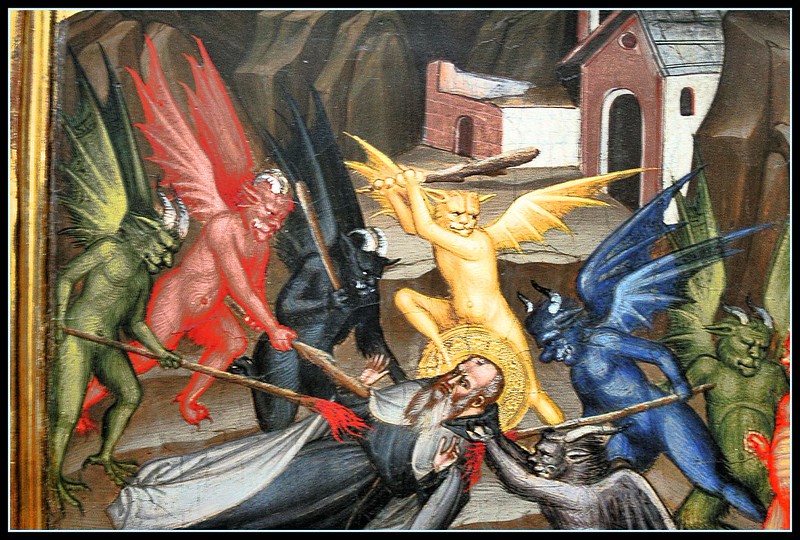
The author, thinking about his latest article. (AKA. Temptation of St. Anthony, Cenni di Francesco di Ser Cenni, Getty Museum, Los Angeles.)
A second part to this is about professionalism and job satisfaction. Writing is indeed hard work, and it’s frustrating when the words won’t flow. But when they finally do and when we’re able to press save for the last time on a truly finished piece, the reward is intoxicating. It’s the reason writing remains the thing I want to do more than anything else. It turns out I don’t entirely work for my clients, or even the agency. I work to appease my own workaday version of Orwell’s demon.
It’s also about the debt writers or their employers owe to their audiences. If a company wants to impress people, be they customers, investors or influencers, then it needs to put the work in. Those audiences are looking to see if you can be trusted, whether you’ve got some good ideas, whether you’re leading or following the crowd. Unless the writing you are creating is 100% functional, people can tell the difference if you try to do that with a machine, and it matters.
Embrace the struggle
It seems I am among a falling number to maintain this view of business writing. The finance publication Barron’s recently analysed a library of 2025 corporate documents and found a staggering growth in the number bearing the signs of AI generation: sentences with an ‘it’s not X, it’s Y’ pattern, a preponderance of em-dashes and figures without real citations, for example.
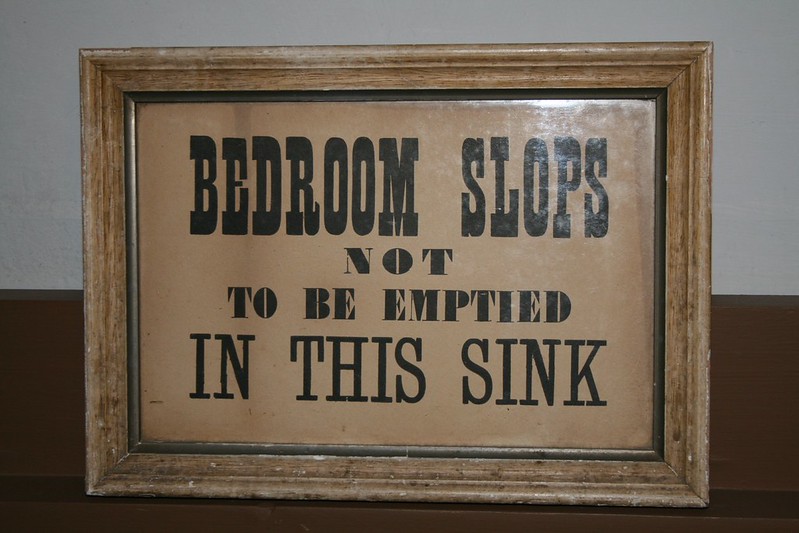
cc2.0: https://www.flickr.com/photos/10978503@N00/7908892860
These were important documents: shareholder letters, reports and press releases. When a company doesn’t even bother to try to eliminate the signs of AI in these documents, it looks very bad. It says it doesn’t care about communicating directly with the customers, investors and influencers who are the intended audiences. It says it’s out of ideas and has nothing fresh to say. It says it’s not a thought leader in anything, because it is relying on a technology that produces the average of what everyone else has already thought.
This is why smart companies will embrace AI where it can help, and there are many, many use cases for this (and we’d be delighted to help you with these). But they’ll also keep some hack like me on their books. Words are important: they create people’s ideas of who you are, how you act, how you think and whether you are trustworthy. They’re worth the struggle.